


Prologue of the series “Biological Immortality of Human”
Throughout the history of mankind, there has been one unchanging condition for life: a person ages and dies. Civilizations arose and disappeared, sciences developed, technology changed the world, but the biological fate of man remained the same. Sickness, ageing and death seemed as inevitable laws of nature as gravity or the change of seasons.
Therefore, for thousands of years, people have been looking for immortality not in science, but in myths.
Ancient cultures told of gods who do not age. Alchemists were looking for the elixir of life. Philosophers have speculated about the soul that survives the body. Religions promised eternal life in another world.
But the 21st century was the first period in history when the question of immortality began to move from the field of mythology to the field of science.
Modern biology has shown that aging is not a mystical process or an inevitable curse of nature. Aging is a set of biological mechanisms: the accumulation of molecular damage, changes in the work of genes, violation of cellular metabolism, the gradual depletion of the body’s recovery systems.
In other words, aging is a problem.
And any problem that can be described scientifically can theoretically be solved.
Humanity has already learned to do what until recently seemed impossible. We deciphered the human genome. We learned to observe the work of cells at the molecular level. We are beginning to understand the mechanisms that drive body development, tissue aging and regeneration.
Moreover, for the first time, we received tools that allow us to interfere with our own biology.
These changes gave rise to a new philosophical direction – transhumanism.
Transhumanism proceeds from a simple idea: a person is not obliged to forever remain the biological being that evolution formed him. Technology could allow us to push the boundaries of human capabilities – improve health, prolong life, increase intellectual capacity, and perhaps one day overcome biological aging.
This does not mean abandoning human nature. On the contrary, it is a continuation of the deepest human tradition – the desire to overcome restrictions.
The fire allowed the man to survive the cold.
Medicine has made it possible to defeat many diseases.
Science has made it possible to understand the structure of the universe.
The next step could allow a person to change themselves.
However, the path to a radical extension of life will not be easy. It will require years of research, great scientific effort and deep ethical reflection. Not all ideas will turn out to be correct. Not all technology will be safe. And perhaps many of today’s hypotheses will be revised.
But another thing is more important: for the first time in history, humanity began to ask the question not “why are we aging,” but “how to stop aging.”
This series of books is devoted to this very question.
“Biological Immortality of Human” is not a promise of eternal life or a fantasy dream. This is a study of what science already knows about aging, what technologies are being developed today and what opportunities may open up in the future.
Each volume of the series considers one side of this problem: the biology of aging, the genetics of longevity, genome editing technologies, the biochemistry of cellular processes, medical technologies of the future, practical strategies for extending life and the philosophical consequences of possible immortality.
We live in a unique historical moment.
For the first time in the history of mankind, people are beginning to understand the mechanisms of their own mortality. And perhaps it is our generation that stands at the beginning of a new era – an era in which aging will cease to be an inevitable fate.
The question is no longer whether a radical life extension is possible.
The question is how far humanity is willing to go to change its own nature.
This series of books is an invitation to this conversation.
Book 6 of 7,
Print length 150,
Language English,
File size 1,5 Mb (Pdf)
Contents
Prologue of the series “Biological Immortality of Human”
Introduction by the author
Longevity Practice
Why life extension starts with everyday decisions.
Part I
Biomarkers of aging
What are biomarkers
Chronological and biological age
Epigenetic clock
Biomarkers of inflammation
Metabolic markers
Hormonal parameters
Telomere length as biomarker
Comprehensive biological age assessment
Part II
Metabolic health
Metabolism fundamentals
Energy balance of the body
The role of insulin
Metabolic syndrome
Glucose control
Insulin sensitivity
Metabolic flexibility
Metabolism and aging
Part III
Nutrition and longevity
History of nutrition research
Calories and life expectancy
Calorie restriction
Interval feeding
Macronutrient balance
Proteins and aging
Fats and health
Carbohydrates and metabolism
Micronutrients
Nutrition of centenarians
Part IV
Physical activity
Motion biology
Muscle and metabolism
Aerobic loads
Strength training
Endurance
Sports impact on the brain
Physical activity and longevity
Optimal training regimens
Part V
Sleep and recovery
Sleep biology
Circadian rhythms
Sleep phases
Sleep and hormonal system
Recovery of the body
Lack of sleep and aging
Part VI
Preventive medicine
Prevention of age-related diseases
Cardiovascular health
Brain health
Immune system
Screening and early diagnosis
Part VII
Health monitoring
Biological monitoring
Personalized medicine
The future of preventive medicine
Epilog
Long life strategy
Biological Immortality of Human (series of 7 books)
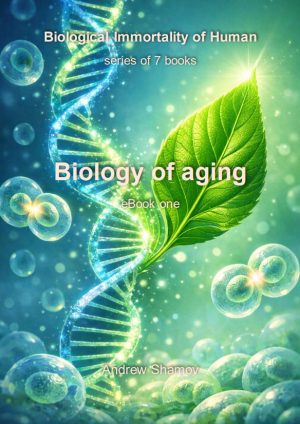
Biology of Aging (book one)
Genetics of Longevity (book two)
Genome Editing Technologies (book three)
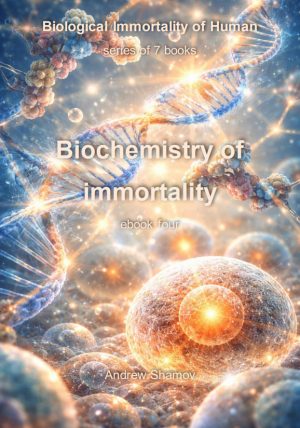
Biochemistry of immortality (book four)
Technologies of the Future (book five)
Practical Life Extension Strategy (book six)
Philosophy of Immortality (book seven)
Author Andrew Shamov
© Shamov.info Publishing House, 2026
Website: aweGene.com
Email: [email protected]