

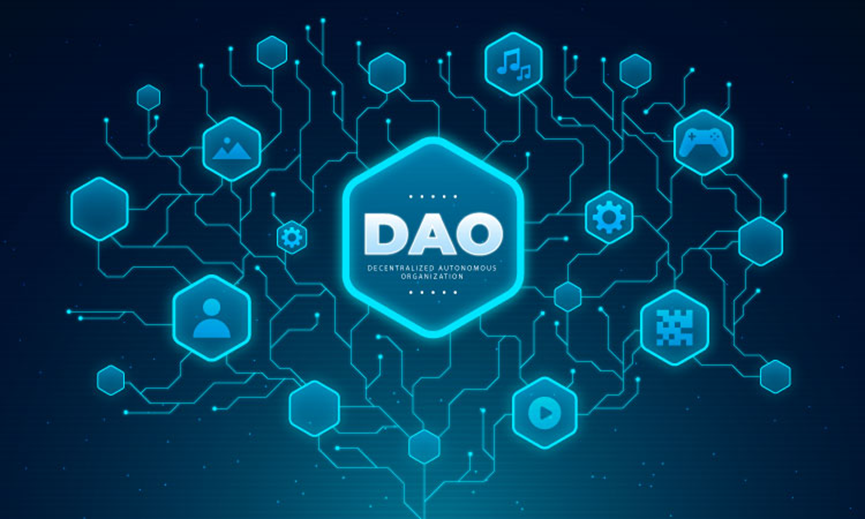
A DAO (Decentralized Autonomous Organization) is a blockchain-based organization governed by smart contracts and community voting instead of centralized leadership.
Unlike traditional companies, DAOs operate transparently on-chain. Members typically hold governance tokens that allow them to vote on proposals, treasury management, partnerships, protocol upgrades, and strategic decisions.
In simple terms, a DAO enables people around the world to coordinate, make decisions, and manage resources without relying on a central authority.
How Does a DAO Work?
A DAO functions through a combination of:
- Blockchain technology
- Smart contracts
- Governance tokens
- Community voting mechanisms
The rules of the organization are encoded into smart contracts deployed on a blockchain such as Ethereum.
When members submit proposals, token holders vote on them. If the proposal reaches the required threshold, the smart contract automatically executes the decision.
Core Components of a DAO
1. Smart Contracts
Smart contracts define the DAO’s rules and automate actions once voting conditions are met.
2. Governance Tokens
Members receive governance tokens that grant voting rights. Usually, the more tokens a participant owns, the greater their voting power.
3. Treasury
Most DAOs manage a shared treasury containing cryptocurrencies or digital assets used for development, grants, investments, or operations.
4. Community Governance
Members collectively decide the future direction of the organization through decentralized voting.
Why Are DAOs Important?
DAOs introduce a new governance model that removes many limitations of traditional hierarchical organizations.
Key Benefits of DAOs
Transparency
All transactions, votes, and rules are recorded on the blockchain and can be publicly verified.
Decentralization
No single person or corporation controls the organization.
Global Participation
Anyone with internet access and governance tokens can participate from anywhere in the world.
Automation
Smart contracts automate processes and reduce the need for intermediaries.
Community Ownership
DAO participants directly influence the development and strategic direction of projects.
Common Types of DAOs
Protocol DAOs
These govern decentralized finance (DeFi) protocols and blockchain ecosystems.
Examples include:
- Uniswap DAO
- MakerDAO
- Aave DAO
Investment DAOs
Communities pool capital to invest in crypto projects, NFTs, or startups.
Social DAOs
These focus on building communities, networking groups, or creator ecosystems.
Grant DAOs
Organizations that fund developers, researchers, and open-source initiatives.
Media DAOs
Community-owned media platforms where members influence content creation and editorial decisions.
DAO Governance Models
Different DAOs implement different governance structures.
Token-Based Governance
Voting power depends on the number of governance tokens held.
Reputation-Based Governance
Influence is earned through contributions rather than token ownership.
Delegated Governance
Members delegate voting power to trusted representatives.
Quadratic Voting
Designed to reduce the influence of large token holders and encourage fairer participation.
Real-World DAO Examples
MakerDAO
One of the earliest successful DAOs, MakerDAO governs the DAI stablecoin ecosystem.
Uniswap DAO
The Uniswap community votes on protocol upgrades, treasury allocations, and ecosystem initiatives.
ConstitutionDAO
A well-known experiment where crypto users pooled funds to bid on a rare copy of the U.S. Constitution.
Advantages of DAOs Over Traditional Organizations
| Traditional Organizations | DAOs |
|---|---|
| Centralized leadership | Community governance |
| Limited transparency | Public blockchain records |
| Geographic restrictions | Global participation |
| Manual administration | Smart contract automation |
| Slow decision-making | Faster on-chain voting |
Challenges and Risks of DAOs
Despite their innovation, DAOs face several important challenges.
Security Vulnerabilities
Bugs in smart contracts can lead to exploits and financial losses.
Whale Dominance
Large token holders may gain disproportionate control over governance decisions.
Regulatory Uncertainty
Many jurisdictions still lack clear legal frameworks for DAOs.
Low Participation
Governance participation rates can sometimes be low, weakening decentralization.
Scalability Issues
As communities grow, governance coordination becomes increasingly complex.
DAOs and the Future of Web3
DAOs are becoming a foundational component of the Web3 ecosystem.
Many blockchain projects now use DAO structures to:
- Govern protocols
- Allocate funding
- Manage ecosystems
- Coordinate contributors
- Build decentralized communities
As blockchain adoption grows, DAOs may eventually expand beyond crypto into:
- Venture capital
- Freelance networks
- Gaming communities
- Social platforms
- Nonprofit organizations
- Digital identity systems
Are DAOs Legal?
The legal status of DAOs varies by country and jurisdiction.
Some regions are beginning to recognize DAOs as legal entities. For example, Wyoming introduced legislation allowing DAOs to register as LLCs under specific conditions.
However, regulatory clarity remains a major issue globally, especially regarding:
- Taxation
- Liability
- Securities laws
- Treasury management
Organizations considering DAO structures should seek legal guidance before launching.
How to Join a DAO
Joining a DAO usually involves a few simple steps:
- Create a crypto wallet
- Purchase governance tokens
- Join the DAO’s community channels
- Participate in discussions
- Vote on governance proposals
Popular platforms for DAO participation include:
- Snapshot
- Tally
- Aragon
- DAOhaus
Frequently Asked Questions About DAOs
What does DAO stand for?
DAO stands for Decentralized Autonomous Organization.
Are DAOs only used in crypto?
Most DAOs operate in the crypto ecosystem today, but the model can also apply to communities, businesses, nonprofits, and online collaborations.
How do DAO members vote?
Members typically vote using governance tokens through blockchain-based voting systems.
Can a DAO own assets?
Yes. DAOs can collectively manage cryptocurrencies, NFTs, treasuries, and other digital assets.
What is the main purpose of a DAO?
The primary goal of a DAO is to enable decentralized decision-making without centralized control.
Final Thoughts
DAOs represent a major shift in how organizations coordinate people, capital, and decision-making in the digital age.
By combining blockchain transparency, smart contract automation, and community governance, DAOs create new opportunities for decentralized collaboration at a global scale.
While challenges around regulation, security, and governance still exist, DAOs are likely to remain one of the most influential innovations in the evolving Web3 landscape.